
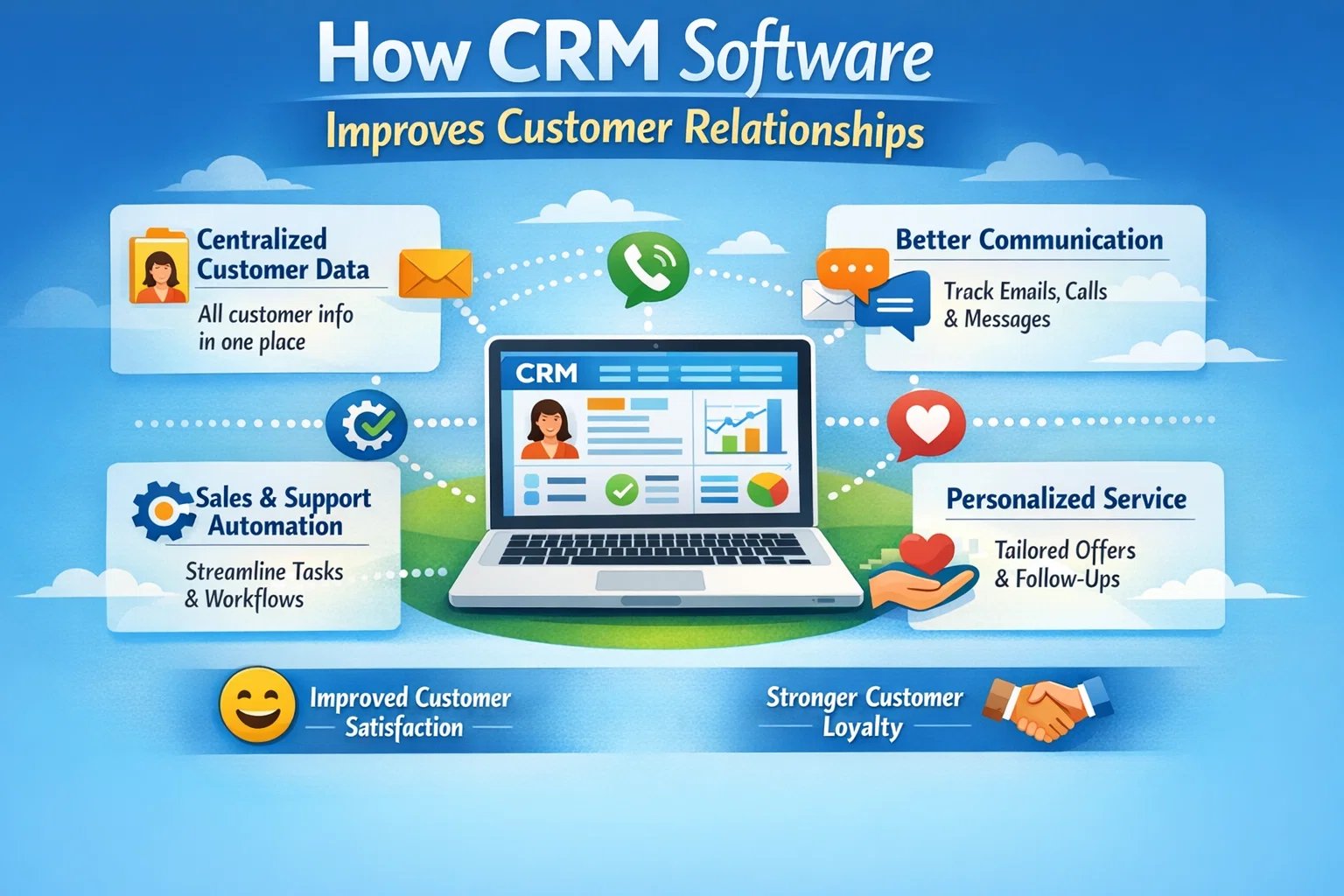
In today’s highly competitive digital economy, customer relationships are the foundation of sustainable business growth. Companies that understand, engage, and retain their customers consistently outperform those that do not. This is where CRM software plays a transformative role. Customer Relationship Management (CRM) systems are no longer optional tools—they are strategic platforms that help businesses build long-lasting, profitable customer relationships.
Across Tier-1 markets such as the United States, United Kingdom, Canada, Australia, and Western Europe, organizations invest heavily in CRM solutions to enhance customer experience, improve retention, and maximize lifetime value. This guide explains exactly how CRM software improves customer relationships and why it delivers measurable ROI.
What Is CRM Software?
CRM software is a centralized system that helps businesses manage interactions with customers and prospects across sales, marketing, and support channels. It stores customer data, tracks communication history, automates workflows, and provides actionable insights that empower teams to deliver personalized experiences.
Modern CRM platforms integrate with email, phone, live chat, social media, analytics, billing systems, and marketing automation tools—creating a complete 360-degree view of each customer.
Why Customer Relationships Matter More Than Ever
Customer expectations have evolved dramatically. Today’s customers demand speed, personalization, consistency, and value at every touchpoint. Poor experiences quickly lead to churn, negative reviews, and lost revenue.
- Increase customer retention rates
- Improve satisfaction and loyalty
- Boost repeat purchases
- Increase customer lifetime value (CLV)
Centralized Customer Data: The Foundation of Strong Relationships
One of the most powerful ways CRM software improves customer relationships is by centralizing customer data. Instead of scattered spreadsheets or disconnected tools, CRM systems store all customer information in one secure platform.
What Data Does a CRM Store?
- Contact details and demographics
- Purchase and transaction history
- Communication logs (emails, calls, chats)
- Preferences and behavior data
- Support tickets and resolutions
This unified view ensures every team member understands the customer journey, enabling more informed and empathetic interactions.
Personalized Customer Experiences at Scale
Personalization is now a core customer expectation. CRM software enables businesses to tailor interactions using behavioral insights and historical data.
- Send personalized emails and offers
- Recommend relevant products or services
- Customize messaging by lifecycle stage
- Deliver targeted marketing campaigns
Personalization strengthens trust, increases engagement, and builds emotional connections with customers.
Improved Communication and Responsiveness
CRM software enhances communication across all touchpoints. Whether customers contact sales, support, or marketing, their full interaction history is instantly available.
- Faster response times
- Consistent messaging
- Reduced repetition for customers
- Higher satisfaction levels
In Tier-1 markets where service standards are high, CRM-driven responsiveness creates a strong competitive advantage.
Automation That Enhances Customer Relationships
Automation is one of the most valuable CRM capabilities. By automating repetitive processes, teams can focus on meaningful human interactions.
Examples of CRM Automation
- Automated follow-up emails
- Lead nurturing workflows
- Customer onboarding sequences
- Support ticket routing
Automation ensures consistent communication, prevents missed opportunities, and strengthens trust with customers.
CRM Analytics and Customer Insights
| CRM Insight | Relationship Impact |
|---|---|
| Customer segmentation | More relevant messaging |
| Purchase patterns | Better cross-sell and upsell |
| Churn prediction | Proactive retention strategies |
| Engagement metrics | Improved customer satisfaction |
These insights allow businesses to anticipate customer needs and deliver value proactively.
Stronger Customer Support and Issue Resolution
Customer support plays a vital role in relationship building. CRM software improves support by providing complete context for every interaction.
- View past issues and resolutions
- Respond faster and more accurately
- Track service-level agreements (SLAs)
- Identify recurring problems
Efficient issue resolution builds confidence and reinforces loyalty.
Omnichannel Engagement Through CRM
Modern customers interact with brands across multiple channels. CRM systems unify interactions across:
- Phone
- Live chat
- Social media
- Web forms
This ensures a seamless and consistent customer experience across every touchpoint.
CRM and Customer Retention
Retention is one of the highest-ROI outcomes of CRM adoption. By analyzing engagement and behavior, businesses can proactively strengthen relationships.
- Loyalty programs
- Proactive outreach
- Renewal reminders
- Customer success tracking
Even small retention improvements can dramatically increase profitability.
Building Long-Term Customer Loyalty
CRM software helps businesses move beyond one-time transactions to create lasting emotional connections. Loyal customers:
- Spend more over time
- Refer new customers
- Provide valuable feedback
- Show lower price sensitivity
CRM Software in Tier-1 Markets
In Tier-1 countries, CRM adoption is driven by strict compliance, high expectations, and strong competition. Businesses rely on CRM platforms to:
- Meet global data protection standards
- Deliver premium customer experiences
- Scale internationally
- Integrate AI-driven automation
The Future of CRM and Customer Relationships
The future of CRM lies in artificial intelligence, predictive analytics, and hyper-personalization. Advanced platforms will increasingly anticipate customer needs and automate relationship management at scale.
Businesses investing in CRM today position themselves for long-term competitive advantage in a customer-centric world.
Final Thoughts: Why CRM Software Is Essential
CRM software fundamentally transforms how businesses build and maintain customer relationships. By centralizing data, enabling personalization, improving communication, and providing actionable insights, CRM systems empower organizations to deliver exceptional customer experiences.
For companies focused on growth, retention, and lifetime value—especially in Tier-1 markets—CRM software is not just helpful, but strategically essential.